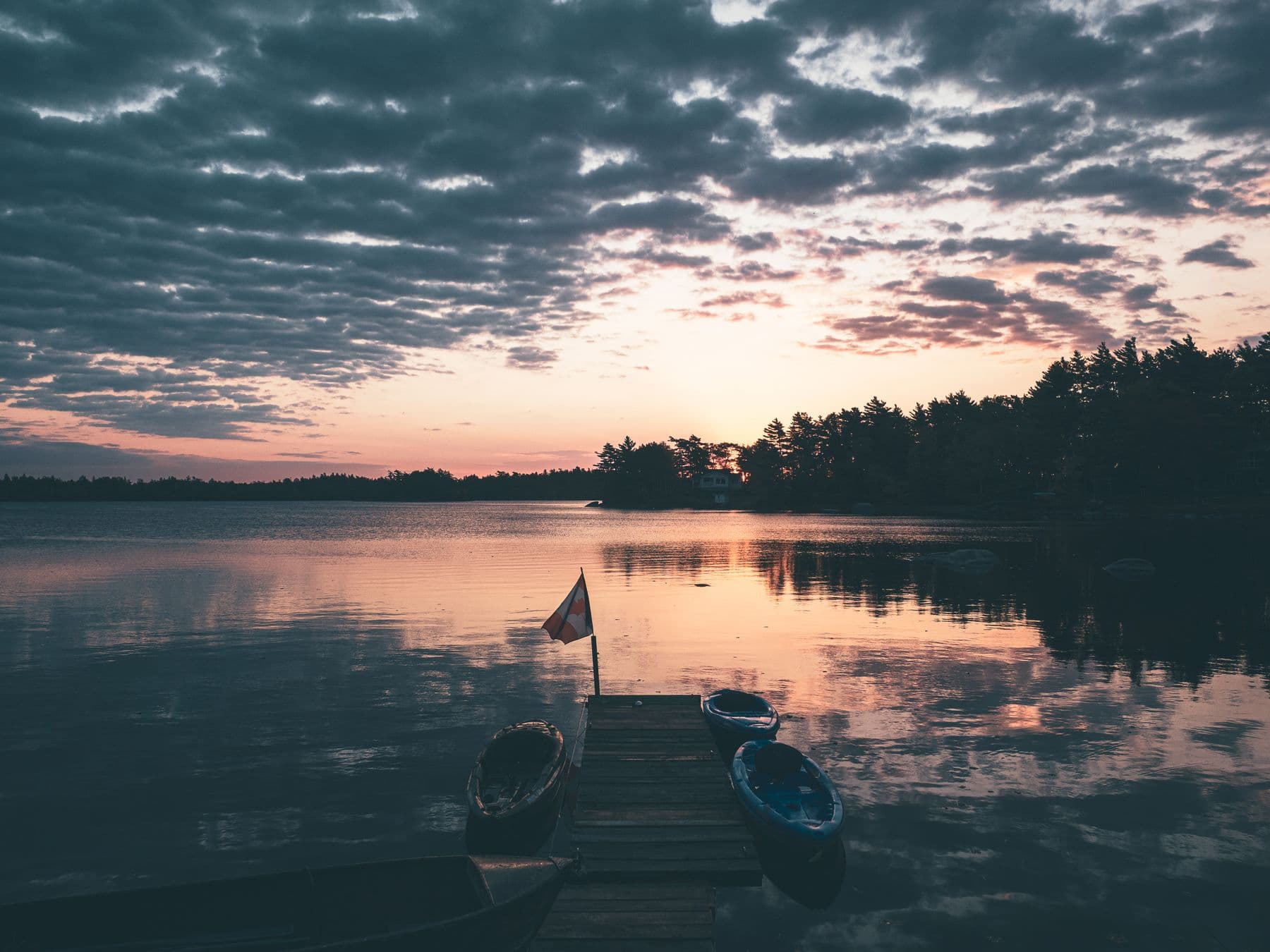
Lawsuit Scenario
Your Boat's Wake Flipped a Canoe: Liability on Canadian Water
By LiabilityGap EditorialUpdated 6 min read
The short answer
Am I responsible for my boat's wake in Canada, and what insurance covers a wake injury claim?
Yes — Transport Canada's safe boating guidance and the federal Collision Regulations place responsibility for wake damage and injury on the operator. A swamped canoe or injured swimmer can produce a claim of $500,000 or more, and it's answered by a dedicated boat policy, not your auto insurance, which covers none of it.
In Canada, you are legally responsible for your boat's wake — and a wake that flips a canoe and puts a paddler in hospital can produce an injury claim of $500,000 or more, plus property damage along the shoreline. There is no no-fault system on the water to absorb it: marine injury claims are straight lawsuits, and the defendant is whoever was driving the boat — and whoever owns it.
Most boaters have never once checked which policy would answer that claim. Here's the scenario, the rules, and the gap.
The scenario#
A composite of what Canadian marine insurers and lake associations see every summer:
August long weekend, a narrow channel between the marina and open water. You're at the helm of your 26-foot bowrider, up on plane because the channel feels empty. Your wake — maybe two feet of it by the time it reaches shore — rolls through a canoe carrying a 58-year-old teacher and her husband. The canoe flips. He surfaces; she doesn't, not right away. She's pulled out after long enough underwater that the hospital keeps her for weeks, and the lasting cognitive injury keeps her from returning to work.
The same wake slams a docked runabout into its lift — $14,000 in hull and dock repairs — and knocks a swimmer off a ladder.
Eight months later: a statement of claim for $1.2 million. Cost of future care, lost income to retirement, housekeeping capacity, pain and suffering. Plus the dock owner's $14,000, which suddenly feels like a rounding error.
You weren't racing. You weren't drinking. You just didn't look behind you.
Your wake is your problem: the rules on the water#
People assume water works like the road — no-fault benefits, standard limits, a familiar system. It doesn't. Boating in Canada is governed federally, and the liability picture looks like this:
| Rule | What it says | What it means for you |
|---|---|---|
| Operator responsibility for wake | Transport Canada's safe-boating guidance: you are responsible for your wake and the damage it causes | Swamped canoes, eroded docks, injured swimmers — the claim points at the helm |
| Federal Collision Regulations | Every vessel must maintain a safe speed and keep a proper lookout | "I didn't see the canoe" is the admission, not the defence |
| Pleasure Craft Operator Card | Required for operating powered pleasure craft (Transport Canada) | No card = an offence, and a gift to the plaintiff's lawyer |
| No provincial no-fault | Provincial auto schemes stop at the shoreline | Injury claims are pure tort — full damages, no cap from a benefits schedule |
| Owner exposure | Owners get named alongside operators | Lending the boat doesn't lend away the lawsuit |
That last row deserves a beat: because there's no no-fault layer, an injured person's only route to compensation is suing you. Their lawyer isn't being aggressive; they're doing the only thing the system allows.
And the wakes themselves are getting bigger. Modern wake-surf boats carry ballast tanks designed to throw a wall of water, and a growing list of Canadian lakes and municipalities now restrict where they can run. A machine engineered to maximize its wake, operated near shore, is an operator-responsibility argument that writes itself — courts don't need a new rule to handle it, just the old one about safe speed and lookout.
What a wake incident costs#
Ranges below are editorial estimates reflecting the pattern of Canadian marine injury and property claims — not quotes or predictions, since every incident turns on its own facts:
| Outcome | Typical exposure (Canada) |
|---|---|
| Swamped boat, gear lost, no injury | $2,000 – $20,000 |
| Dock and moored-boat damage | $5,000 – $50,000 |
| Injury with full recovery | $25,000 – $150,000 |
| Near-drowning, lasting impairment | $500,000 – $2 million+ |
| Fatality with dependants | $1 million+ |
The expensive lines are the ones nobody pictures when they open the throttle. Cold-water immersion and near-drowning injuries generate exactly the claim heads Canadian courts award biggest: future care and future income loss, calculated over decades.
How exposed are you? Most people have no idea.
10 questions. 2 minutes. No email needed to see your score.
Check my lawsuit exposureWhich policy responds — and where it stops#
Start with the policy that doesn't: your auto insurance covers none of this. Not the boat, not the wake, not the injury. Boats are simply not motor vehicles under any Canadian auto scheme.
That leaves two candidates:
- Your homeowner policy — but only for small, low-power boats. Most Canadian home policies extend personal liability to modest watercraft, commonly capped around 25 horsepower or less (thresholds vary by insurer — check your wording, not your memory). A canoe, a small tinny with a kicker motor: usually fine. A 26-foot bowrider: not a chance. And personal watercraft are frequently excluded from homeowner coverage entirely.
- A boat policy. Anything bigger needs its own marine policy, which typically carries $1 million — sometimes $2 million — in liability coverage and pays your legal defence. This is the policy that answers the composite claim above.
Now the gaps:
- No boat policy at all. Boat insurance isn't legally mandatory in Canada, so plenty of boats on the water carry none. Against a $1.2 million claim, "optional" becomes "everything I own."
- The limit. A $1 million boat policy against a $1.2 million claim leaves you $200,000 short before defence costs are counted — and one bad near-drowning can run far past that.
- Policy conditions. Marine policies care about who was driving, whether they held a PCOC, and whether the boat was used as described. Breach a condition and the insurer may deny the claim outright.
How umbrella coverage changes the outcome#
A personal umbrella policy sits above your underlying policies — home, auto, and boat — and adds $1 million to $10 million of protection. Typical Canadian pricing runs roughly $200–$300 per year for the first $1 million and about $50–$75 per year for each additional $1 million (estimates based on typical broker pricing, not quotes).
On the water, the mechanics have two hard requirements:
- The boat must be declared. Umbrella insurers extend over the watercraft they know about. An undeclared boat is an uncovered boat.
- The underlying boat policy must be in force at the required limit. The umbrella pays above your boat policy, not instead of it. Let the marine policy lapse and the umbrella can refuse to drop down.
Do both, and the picture changes completely: the boat policy pays its $1 million, the umbrella catches the rest of the judgment and typically keeps funding your defence. The $1.2 million claim becomes a bad summer instead of a forced house sale.
The bottom line#
On the road, a serious injury triggers a system — no-fault benefits, mandatory limits, familiar process. On the water there is no system. There's just you, your wake, and whatever policy you did or didn't buy. Check three things before the next long weekend: that the boat actually has its own liability policy (your home policy almost certainly isn't covering that horsepower), what the limit is, and whether your umbrella — if you have one — knows the boat exists.
Four seconds of throttle in a narrow channel can cost more than the boat, the truck, and the cottage combined.
You checked the boat's gas. Now check your liability limit — 2 minutes.
10 questions. 2 minutes. No email needed to see your score.
Check my lawsuit exposureFrequently asked questions
Am I responsible for my boat's wake in Canada?
Yes. Transport Canada's safe-boating guidance and the federal Collision Regulations put responsibility for wake damage and injury on the operator. If your wake swamps a canoe, injures a swimmer, or damages a docked boat, the claim comes to you.
Does auto insurance cover my boat?
No. Auto insurance never covers boats or personal watercraft, even while towing them on a trailer only the trailer itself is typically covered. Boat liability comes from a homeowner policy (small, low-power boats only) or a separate boat policy.
Does home insurance cover boat liability?
Only for small, low-power boats — many Canadian homeowner policies limit liability coverage to boats under roughly 25 horsepower, and the exact threshold varies by insurer. Anything bigger, faster, or personal-watercraft-shaped needs its own policy. Check your wording.
Is there no-fault insurance for boating accidents?
No. Provincial no-fault and accident-benefit schemes apply to motor vehicles on roads, not vessels on water. Injury claims on the water are straight tort claims — the injured person sues the operator and owner, and damages are whatever a court awards.
What licence do I need to drive a boat in Canada?
Operators of powered pleasure craft need a Pleasure Craft Operator Card (PCOC) issued under Transport Canada rules. Operating without one is an offence, and it's an ugly fact to explain to a court after your wake put someone in hospital.
Does umbrella insurance cover boating accidents?
Typically yes — a personal umbrella policy can extend over your boat policy and add $1 million or more of protection. But only if the boat is declared to the umbrella insurer and the required underlying boat policy is in force.
Sources
- Preparing to operate your vessel — Transport Canada
- Collision Regulations, C.R.C., c. 1416 — Justice Laws Website, Government of Canada
- Pleasure Craft Operator Card — Transport Canada
How exposed are you? Most people have no idea.
10 questions. 2 minutes. No email needed to see your score.
Check my lawsuit exposureKeep reading
- The complete guideUmbrella Insurance in Canada: The Complete Guide
- RelatedA Snowmobile Collision on the Trail: Liability in Canada
- RelatedSued Over a Google Review: Defamation Liability in Canada
- RelatedYour ATV Passenger Is Seriously Hurt: Who Pays?
- RelatedDoes Umbrella Insurance Cover Your Boat?
- RelatedA Multi-Vehicle Pileup: When One Policy Limit Meets Five Claims